
New Article on N2SIMBA: a microbial community simulator published in Frontiers in Bioinformatics!

We’re excited to share that our latest paper is now published in Frontiers in Bioinformatics: β€œN2SIMBA: from Network topology to SIMulation of interactions and BActerial abundance, using microbial consumer resource model.”

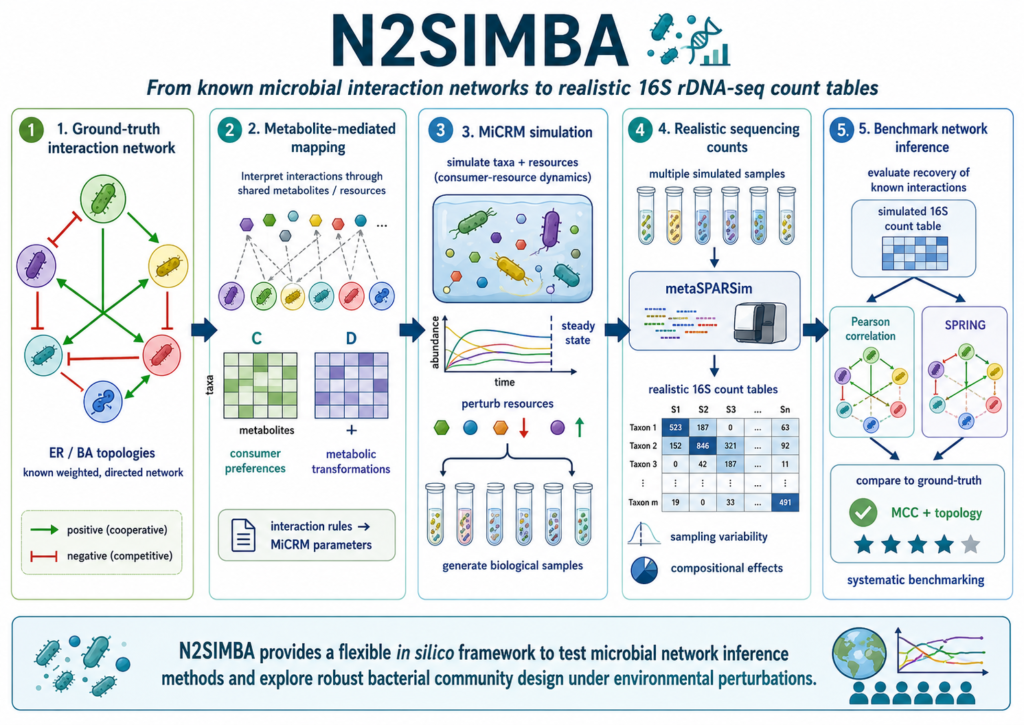
In this work, we introduce N2SIMBA, a modular simulation framework designed to generate realistic 16S rDNA-seq count tables starting from known microbial interaction networks. Since experimentally validated ground-truth interaction networks are rarely available, especially for complex bacterial communities, N2SIMBA provides a flexible in silico tool to systematically benchmark network inference methods.

The framework leverages the Microbial Consumer Resource Model to simulate microbial community dynamics through metabolite-mediated interactions, accounting for both competitive and promotional effects between taxa. By combining ecological modelling with sequencing count simulation, N2SIMBA enables users to study how community composition changes under different network topologies, environmental conditions, and perturbations.

We hope this framework will be useful for researchers interested in microbial ecology, systems biology, and the design of robust bacterial communities. New features and extensions are already under active development!.

Congratulations to Matteo Baldan, Giacomo Baruzzo, Piero Mariotto, Ada Rossato, Marco Cappellato, and Barbara Di Camillo for this work.

The paper is available at: https://doi.org/10.3389/fbinf.2026.1783447
New article on biologically informed feature summarization in spatial transcriptomics now published!

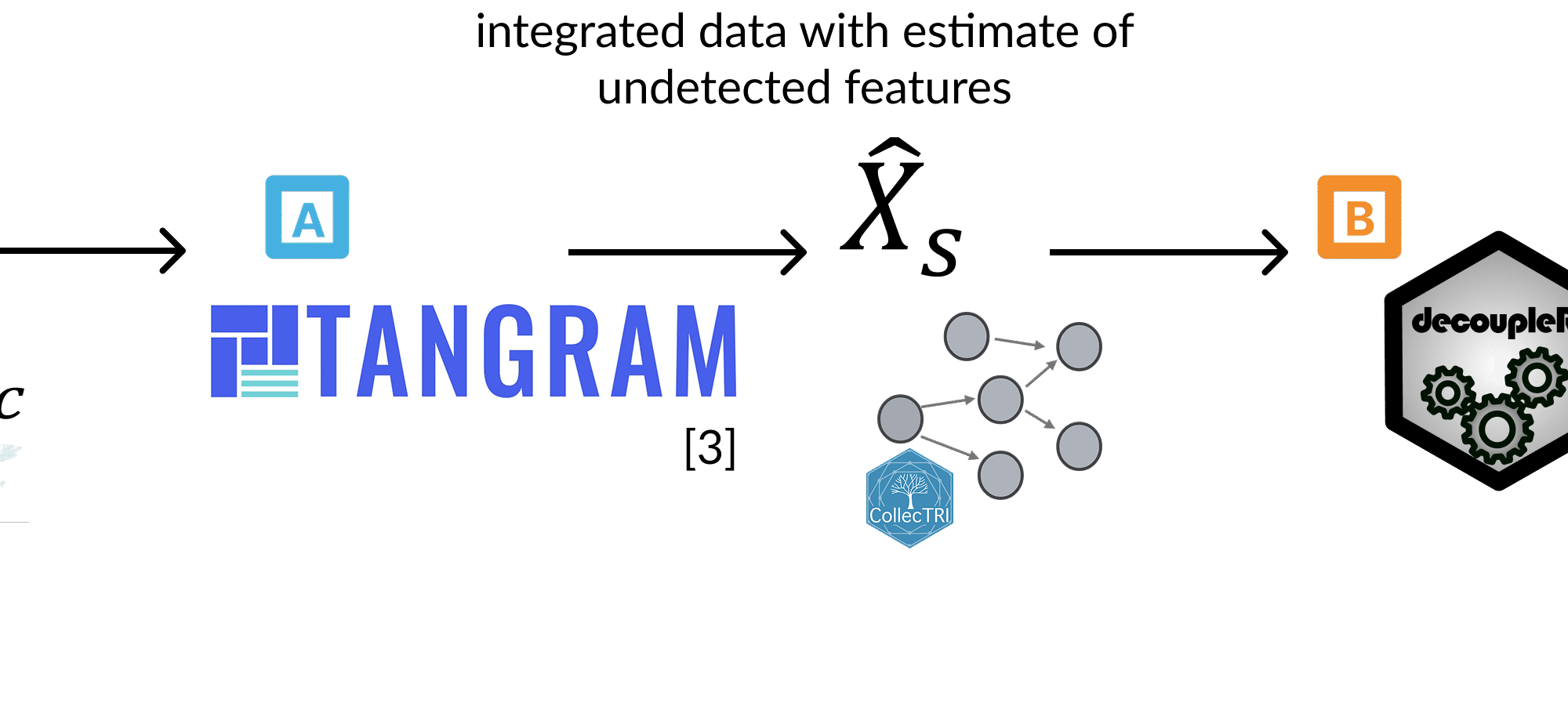
procedure scheme

πŸš€ We’re excited to share that our latest paper is out: Biologically Informed Procedure for Feature Summarization in Spatial Transcriptomics β€” a new framework designed to uncover the spatial organization of rare yet biologically crucial features, such as transcription factors, in imaging-based single-cell RNA sequencing data (e.g., MERFISH).

πŸ“Š In this work, we introduce a comprehensive procedure that integrates:
β€’ TANGRAM, to align and integrate MERFISH with scRNA-seq data.
β€’ Decoupler with COLLECTRI prior knowledge, to derive biologically grounded activity scores for transcription factors.
β€’ Spatial statistics, to detect spatially informative features and highlight their organizational patterns across tissue sections.

πŸ” By combining these elements, our workflow enables the discovery of subtle yet functionally relevant spatial signatures that would otherwise remain hidden β€” providing a powerful tool for interrogating tissue architecture in single-cell spatial genomics.

πŸ‘₯ This achievement was made possible thanks to the collaborative work of all authors and the support of the IJCNN organizers. Special thanks to the members of SysBioBiG – Systems Biology and Bioinformatics Group at UNIPD, who shared this journey with us.

πŸ”— The paper is available at: https://doi.org/10.1109/IJCNN64981.2025.11227921

Systems Biology and Bioinformatics Group
Privacy Overview

This website uses cookies so that we can provide you with the best user experience possible. Cookie information is stored in your browser and performs functions such as recognising you when you return to our website and helping our team to understand which sections of the website you find most interesting and useful.